Showing posts with label Caribbean. Show all posts

Monday, 20 December 2021

Jamaica Debates Commission Should Revise Criteria for Debate Participation

Mario Boothe

Youth & Governance Advocate


JDC Logo
Allowing for differing views and opinion on policy to contend is a critical tenant of democracy, yet the Jamaica Debates Commission (JDC) current setup seems to be ignoring the opinion of our newest political parties and those that identify with their ideology.

In May 2017, the Jamaican parliament in its wisdom approved the “Political Parties Registration Regulations”, this move was to provide for greater transparency and accountability. This also solidified these organizations as part of the democratic and electoral processes in a way they never did before. This registration includes providing organizational structures, gaining signatures and other details.

Only four (4) political parties have so far registered, the Jamaica Labour Party (JLP) and People’s National Party (PNP) along with 2 newer parties including the United Independents’ Congress (UIC) and the Jamaica Progressive Party (JPP).

On November 4th, 2021, the JDC conducted a signing of a MOU that saw the PNP and JLP commit to being a part of the organized debates ahead of the Local Government elections. The exclusion of the JPP and UIC, that are considered “third parties” on the surface may not seem like much, but this should call into question the legitimacy of the election debates.

These third parties are representing concerns not expressed by the establishment options. This was clearly displayed by the UIC’s attempted march on Gordon House this summer.

The JDC’s “Debate Manual” that outlines requirements for political party participation in debates says it cannot be the role of the JDC to provide a platform for political parties to attract national attention, in same breath outlining the hurdles that would limit third party chances in elections. The manual also outlines having public support and ability to form government (fielding candidates and providing policy) as criterion.

With General Election turnout dipping below fifty percent of recent, and Local Government elections trending even lower, it is almost certain to say that no political party has gained the confidence of majority of eligible voters.

It must be suggested that the current JDC manual and format is outdated given the legislative updates and the electoral/political realities.

The commission as a national effort by the media and private sector is excellent, but it should revaluate the necessity to rigorously gatekeep participation, when the limited opinions of the 2-party system has clearly not worked well for the people of Jamaica.

Thursday, 4 February 2016

Will North East St. Elizabeth Start a Political Revolution in Jamaica?

On February 25th the voters of North East St Elizabeth will be going to polls to choose from 4 candidates (1PNP, 1JLP, 1PNP-Independent and an Independent) that have declared their interest in being the Member of Parliament for the constituency well-known as a People National Party (PNP) stronghold or garrison. But should the word “revolution” will be tagged to the race that could possible see the first Independent Member of Parliament (MP) be elected to Gordon House?


One of the Independent candidates Joseph Patterson, President of the United Independent Congress (UIC) in an interview with the Jamaica Observer, believes his campaign; victory and following historic entry into Parliament would “bring forth arevolution like never before” being the first elected Independent MP.  The United Independent Congress’s platforms are based on strong constitution and governance reform, and Mr. Patterson is committed to bringing the Congress’s platforms to parliament; reforms that the current political establishment has been unwilling to touch for over 53years.

Why is it a Revolution?       

To understand why the outcome of the North East St Elizabeth electoral race may be framed as a revolution we must first know what revolution is; the Oxford     dictionary assigns two definitions to the word “revolution”, firstly “a forcible overthrowof a government or social order, in favour of a new system,” secondly “adramatic and wide-reaching change in conditions, attitude or operation.”

Within the context of Jamaica, a two party system controlled by elected representations at both central and local government, a revolution would constitute any disruption to this system of government. We should not underestimate the ability of Jamaicans to recognize “change” as swing accordingly, hence there is no doubt in my mind that constituents in other areas of island will begin to question their own situation and stop settling for “the lesser evil.”

This change in attitude towards politics, governance and what we must begin expect and demand will no doubt only come when a single constituency decided to spark something much bigger than North East and give back Jamaica its Independence almost 54 years after it exchanged one master for another.


via GIPHY

Wednesday, 9 December 2015

Haiti Elections 2015: Political Intervention, CARICOM Deficiencies & Missing Aid

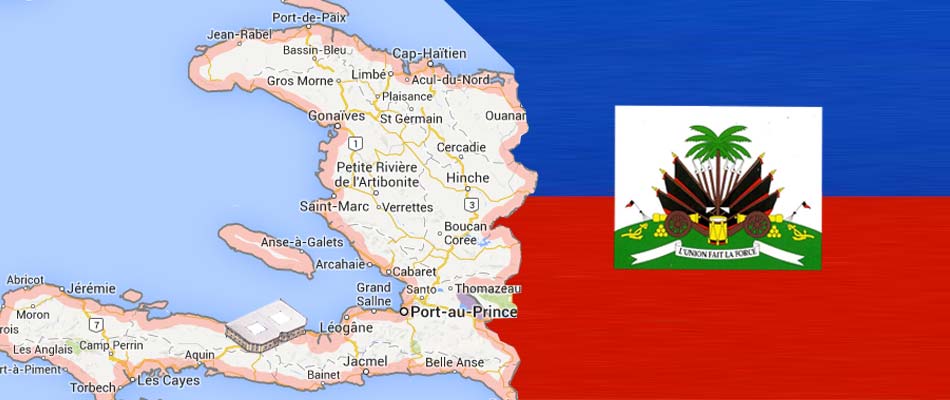
Map of Haiti/Haitian Flag
It is no secret that elections underway in Haiti have been filled with allegations and reports of wide spread fraud, intimidation, violence, external interference and general corruption; all are components of past and recent Haitian democratic processes.

But with the Nation still recovering from a devastating earthquake that only served to weaken its public institutions, the United States' State Department has taken guidance over the current presidential vote, with CARICOM merely an observer to the proceedings.
Democracy Protests

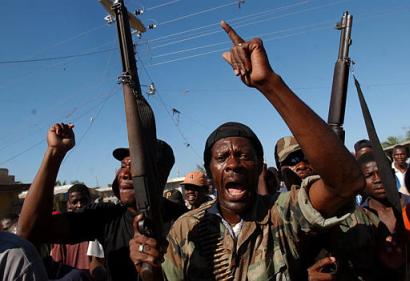
Even as the State Department overlooks the process there are further reports of misconduct among the political actors only adding to growing unease of the common Haitian and placing democracy further away from them.This has led to on/off clashes between democracy protesters and Haitian security forces before, during and after the voting in August and October. Voting continues in December with still occurring clashes daily.

Haiti Special Coordinator Kenneth Merten 
In his teleconferenced remarks on November 16th about the Haiti elections, Haiti Special Coordinator Kenneth Merten acknowledged "the disagreements" among the political players then stated "the good news is that the elections are taking place" and response to a question asked by the moderator Dr.Theramene(Haitian Americans for Progress) to elaborate on whether or not there is political interference by his government, Merten explained "We will work with whoever or whatever president comes out of this process." Even if 900,000 party monitors received credentials to vote at multiple voting centers.


Haiti Military Coup
His statement falls inline with the subvert quarters of US foreign policy which is protect their interest though by inducing "stability" - the key word - in simple terms, the works of democracy are shelved for a government, any government so that business as usual may carry on.


The flip side to that shortcut approach is that the peoples dissatisfaction and the governments spoon fed power often end up clashing and this creates instability leading to what we saw in Haiti before in the military coup..


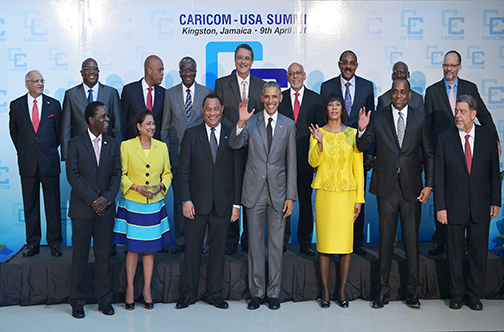
POTUS Obama & CARICOM PMs

The United States(US) is apart of a Core Group in Haiti and as stated by Merten, that includes Brazil, Canada, France, Spain, European Union and representatives of the OAS; the US has the major influence and is working accordingly.With the US committing $31 Million to support election activities its not too cynical to say they will expect value for their money.


Why CARICOM's Limited Role?


The group with least influence though and seemingly with the least interest in the Haiti's current critical democratic redevelopment is the 'regional' body: Caribbean Community (CARICOM) and the Caribbean people, with little to no Caribbean media coverage of the current events.


Not to unfair to the regional body and its people, CARICOM past actions of support for Haiti count as admirable between the banning of illegitimate Latortue government, Aid, observer missions to recent support against Dominicans Republic's policy making Haitian descendants stateless.

Although most of the electoral observer missions were joint operations with the Organization of American States(OAS). CARICOM  has once again limited itself to spectator seat of a overheated election.


The Caribbean media on the other hand seem to have descended past the usual local market driven news content when it comes to Haiti with almost a complete black with most content coming from extra regional sources.I will not question the news editor choices but only urge newsroom rooms regional to encourage regional interest of some sort.


But Haiti has long been wrongly classified as the stepchild of the Caribbean and continues to be seen as economically 'dispensable' and a "burden"  to CARICOM. Although Haiti's relationship with the organisation has not been steady since its admission in 1999 there is no question in my mind that this is a critical juncture for Haitians in their redevelopment.

CARICOM needs t be ready to gain and have greater influence for the strengthening of a regional integration with shared values,similar economies, common culture and geopolitical interest the reasons deepen Haiti-CARICOM relations out weigh disadvantages.


CARICOM's ability to intervene as the regional overseer is hampered not only by financial andresources restraints but by its own unwillingness to create powers to intervene beyond strong worded statements and the cold shoulder:

Hon. Dr.Kenneth Anthony

Hon.Dr.Kenny Anthony of St. Lucia noted in a speech delivered in 2001: "The organization [CARCOM] is not fully seized of the significance of its involvement."   

This calls for reform and restructuring of the regional organization to better suite the current regional integration unions and political-economic area blocs that supports wider influence locally, regionally and internationally.

C.Grant states in his 2007 paper for "Intervention, Border and Maritime Issues in CARICOM" entitled "CARICOM:Non-Intervention & Intervention" that

While the current diplomatic modus operandi has served the Community reasonably well, there is the need for indicators for intervention to be developed and for a formal institutional mechanism to mediate political conflicts among stakeholders in the political process of the various Caribbean states to replace the reliance on ad hoc interventions such as those utilized in Guyana and St. Vincent and the Grenadines.”

Humanitarian Fail: Where are the Missing Aid Funds ?

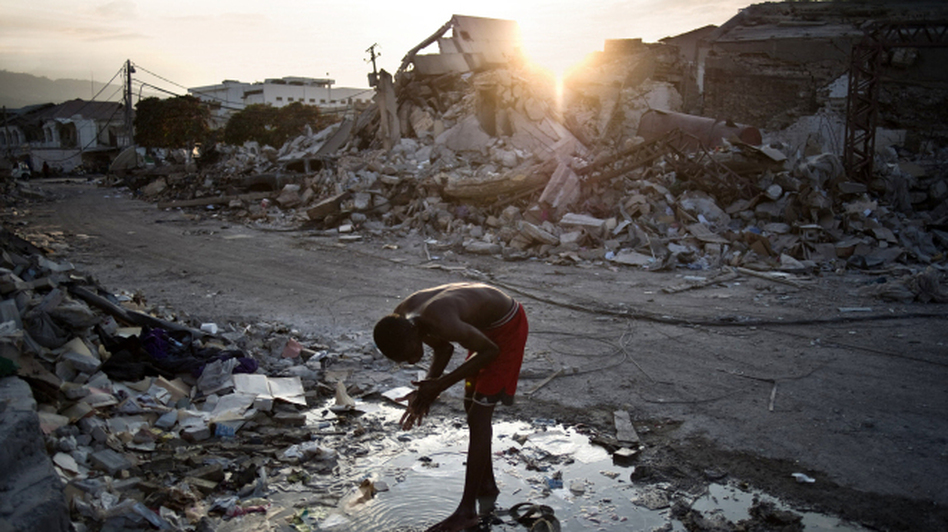
Haiti 2010 Earthquake Aftermath (NPR)

I end on an extremely sour humanitarian note that concerns Haiti's aid pledge; Its reported that of 15 000 homes promised to be built only 900 have been delivered, US $7.6 billion has been disbursed and little to show for it, lack of accountability leading to corruption surrounding aid, relief and rebuilding expenditure means the many of those suffering from the 2010 quake are still in tents, on the streets, children not attending school, living conditions and hygiene at inhumane levels.


By all means Haiti is still in the midst of a Earthquake and its allies lead by the US and CARICOM are not back to pre-2010 misconceptions, mistreatment and disregard of Haiti-Pearl of the Caribbean and the free Haitian people.